Here’s the line everybody skips over on the way to the miracle. The disciples had a clean, reasonable plan for the hungry crowd. Send them away. Let them buy their own food. It’s late, we’re broke, this isn’t our problem. And Jesus looked at them and said no. He said, “You give them something to eat.”
That’s the part that should stop you cold. Not the loaves. Not the fish. That one sentence, where Jesus takes a problem the disciples wanted to hand off, and hands it right back to them.
Let me tell you the whole thing, because this is the only miracle of Jesus’s ministry told in all four Gospels. Matthew, Mark, Luke, John — all four writers, who agree on almost nothing about the order of events, all stop and tell this one. That alone should make you lean in. Whatever this story is, the early church did not want it lost.
A huge crowd had followed Jesus out to a lonely place. Thousands of them. The counts say five thousand men, and Matthew adds “beside women and children,” so the real number was bigger. And it got late. People were hungry. And the disciples did the sensible thing — they came to Jesus with a logistics problem.
Send them away, that they may go into the country round about, and into the villages, and buy themselves bread.Mark 6:36
Read that again. It isn’t cruel. It’s practical. There’s no food out here, we don’t have money, the responsible move is to dismiss them so they can go take care of themselves. Any of us would have said it. Most of us do say it, every day, about people we can’t fix.

And Jesus refuses. Three of the four Gospels put it the same blunt way: “Give ye them to eat.” In the Greek, the “you” is heavy, pointed, emphatic — you feed them. He will not let them make the hungry someone else’s job.
The disciples do the math out loud, and the math is hopeless. Two hundred pennyworth of bread wouldn’t be enough — two hundred denarii, and a denarius was a day’s wage, so we’re talking most of a year’s pay just to give everyone a bite. They don’t have it. Nobody has it. The problem is too big and the resources are too small. That’s scarcity, and scarcity always sounds like common sense.
Then John tells us something the other three don’t. There was a boy in the crowd. And this boy had a lunch — five barley loaves and two small fish. Barley bread. That’s the cheap bread, the poor person’s bread. A kid with a sack lunch.
There is a lad here, which hath five barley loaves, and two small fishes: but what are they among so many?John 6:9
“But what are they among so many?” Even the disciple who found the boy can hear how absurd it is. Five little loaves against thousands of empty stomachs. It’s nothing. It’s a joke.
And Jesus takes the nothing.
He has everyone sit down on the grass. He takes the boy’s five loaves and two fish, and he blesses them, and he starts breaking, and handing it out. And here the text does something it will not let you soften. The food keeps coming. It goes out and out and out, and it does not run dry. This isn’t the crowd sheepishly pulling hidden snacks out of their cloaks — that’s a story people invented centuries later because a multiplication made them uncomfortable. The Gospels don’t say that. The Gospels say Jesus fed them. All four call it a sign.
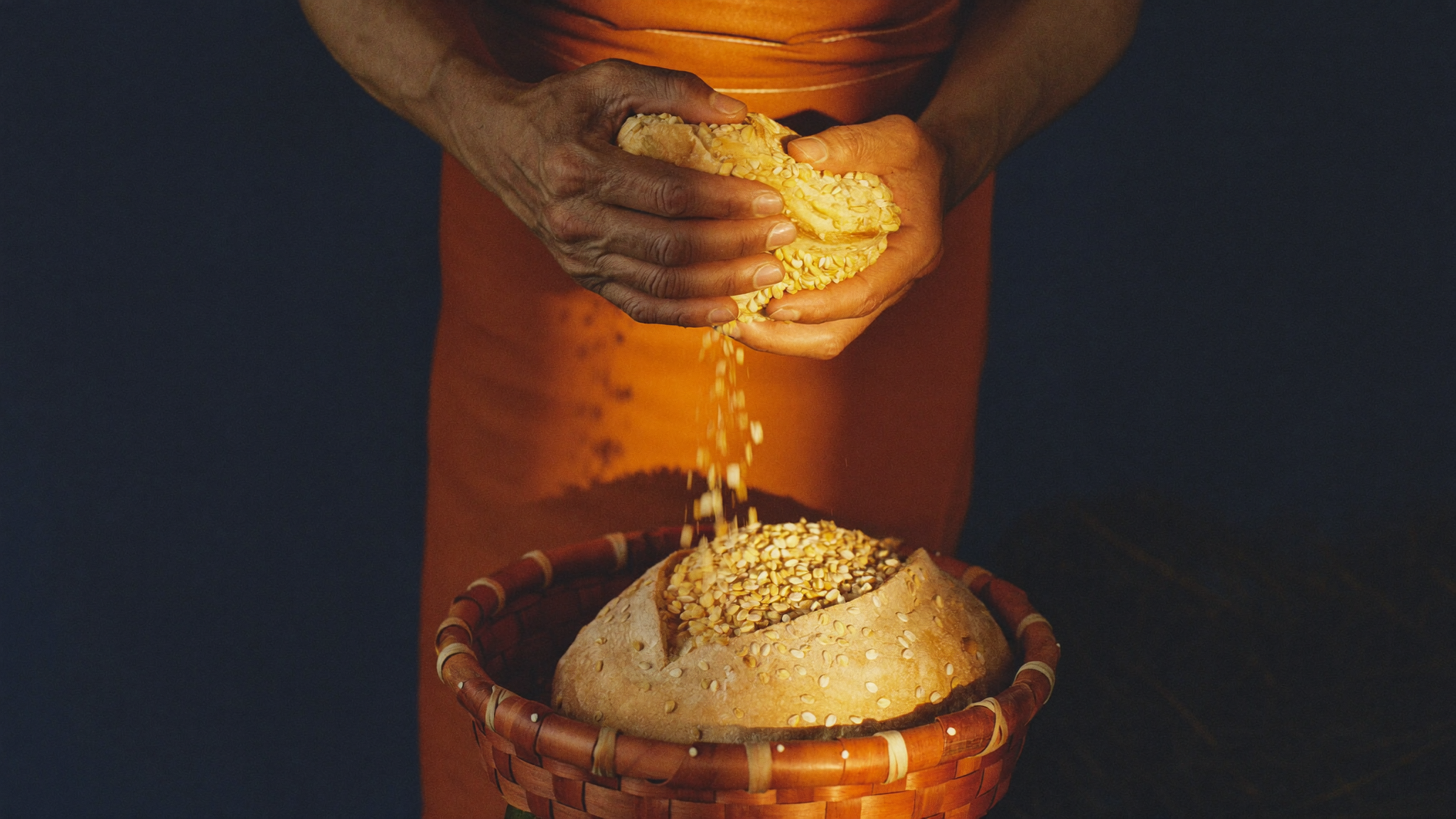
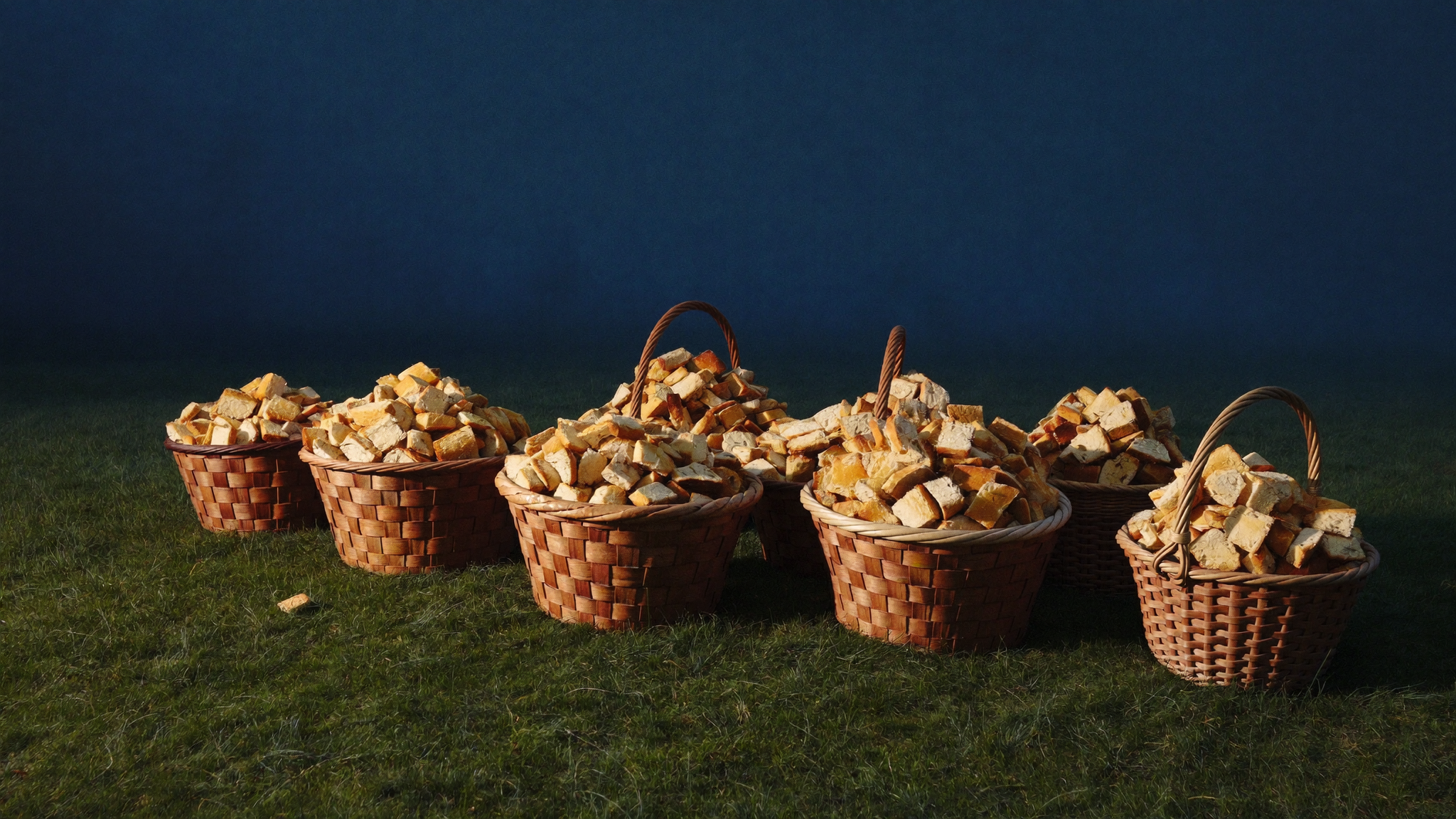
And everyone ate. Not nibbled — the word means filled, satisfied, gorged. “They did all eat, and were filled.” Then Jesus tells them to gather the leftovers so nothing is wasted, and they pick up twelve baskets of scraps. Twelve baskets more than they started with. They began with a boy’s lunch and ended with more food than one boy could carry.
Hold both halves of that, because the story won’t hand you just one. Yes, it’s a miracle — food that couldn’t feed a crowd fed thousands, and only God does that. And it’s also this: the whole thing turned on somebody refusing to send the hungry away. On a boy handing over the little he had instead of protecting his own lunch. The divine act and the human act are both in the frame. Jesus multiplied — but he multiplied what a child was willing to give.
That’s the pattern, and it runs against everything scarcity teaches us. Scarcity says there isn’t enough, so protect yours, so send them off to fend for themselves. This story says: bring me the little you have, feed the crowd in front of you, and watch what enough actually looks like. Twelve baskets over.
Maybe you’ve been the crowd. Maybe you’ve been the one somebody looked at and decided you were too much, too many, too expensive to deal with — go buy your own bread, go handle yourself, you’re not our problem. If you’ve ever been the person other people wanted to send away, hear this. Jesus was the one in the story who wouldn’t let them do it. He looked at the crowd everyone else wanted gone, and he was moved with compassion, and he stayed, and he fed them until they were full.
That’s who he is. That’s the God under all the fear-talk you were handed.
Come find us online, where we’re going back to the old stories and finding the God who feeds the crowd instead of sending it away. Bring what little you’ve got. There’s more than enough at this table, and there’s a place at it for you.