The son had a speech ready. He never got to give all of it.
That is the whole secret of this story. A boy who wrecked his life practiced a careful apology on the long road home. He was going to offer his father a deal. And his father tore the deal up before the boy could finish saying it out loud.
Jesus told this story to answer a complaint. Religious leaders were grumbling that he sat and ate with the wrong kind of people. Their exact words were that he “receiveth sinners, and eateth with them.” So Jesus told them about a father and two sons, and he built the whole thing to answer that grumble.
The younger son does something cruel. He walks up to his living father and asks for his share of the inheritance now. In that world, that was like saying, “I wish you were already dead. Give me the money.” And the father does. He hands it over. The boy leaves, spends every coin, and ends up starving in a field, feeding pigs, so hungry he eyes the pigs’ food.
Then something turns in him. The text says he “came to himself.” He remembers his father’s house, where even the hired workers eat well. And here is where he writes his speech.
I will arise and go to my father, and will say unto him, Father, I have sinned against heaven, and before thee, And am no more worthy to be called thy son: make me as one of thy hired servants.Luke 15:18-19
Look at that last line closely, because it is the whole point. “Make me as one of thy hired servants.” He is not asking to be a son again. He is asking for a job. A wage. He wants to come back and work off what he owes. Pay it down, day by day, until the ledger is clean. He has already decided that grace has to be earned, so he shows up with a repayment plan in his pocket.

Now watch what the father does. The boy is not even close yet. He is a dot on the horizon.
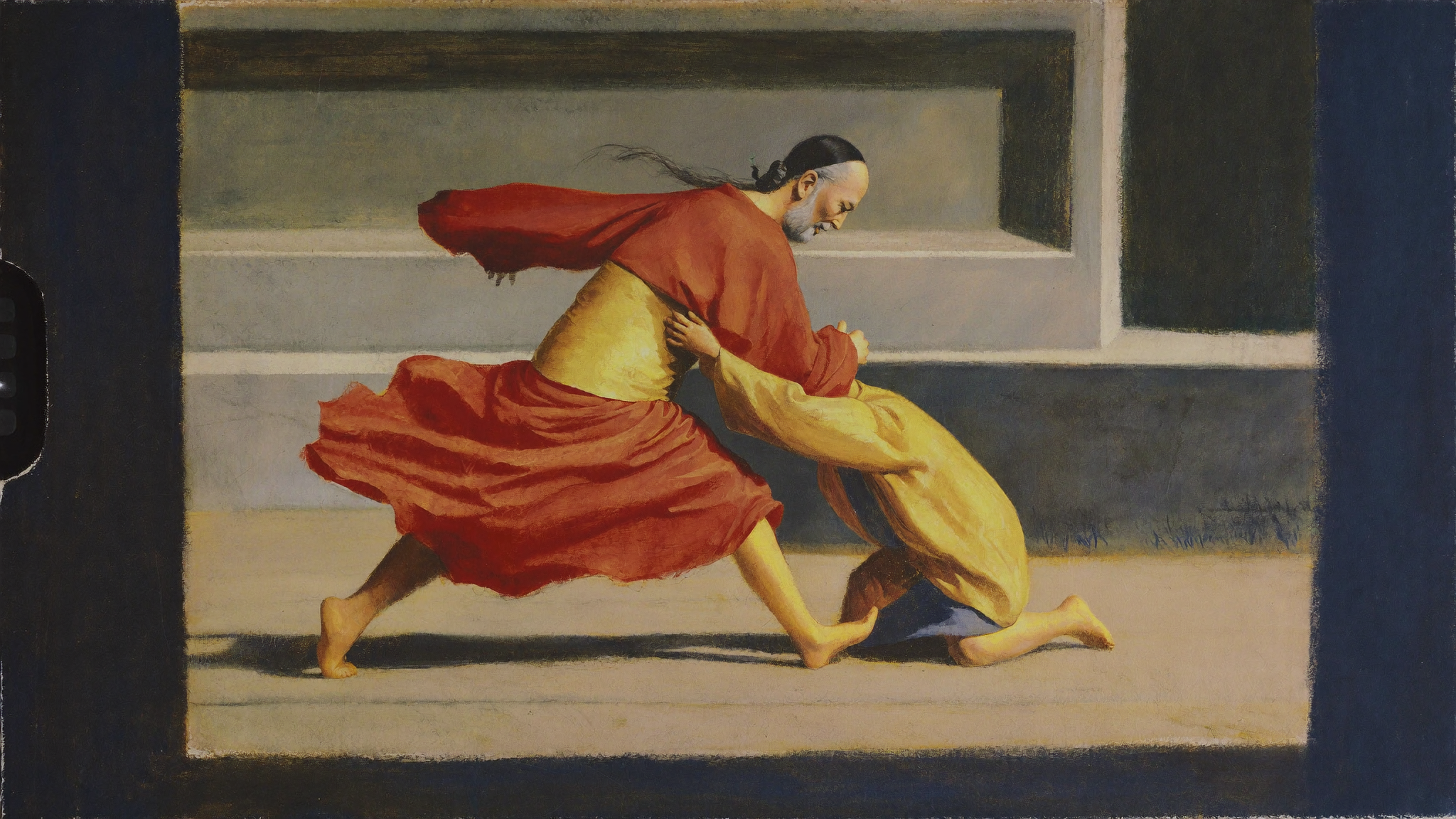
But when he was yet a great way off, his father saw him, and had compassion, and ran, and fell on his neck, and kissed him.Luke 15:20
Every warm thing happens before a single word is spoken. The father saw him. Felt for him. Ran to him. Threw his arms around his neck. Kissed him. The boy has not confessed. He has not apologized. He has not offered his little deal. And already he is being held.
The son begins his speech anyway. “Father, I have sinned against heaven, and in thy sight, and am no more worthy to be called thy son.” He says the sad part. But if you read his words in the older Bibles, you will notice something is missing. The line about the hired servants, the pay-it-back line, never comes out of his mouth. The father does not answer it. The wage offer just dies in the boy’s throat. It never becomes real, because the father is already busy doing something else entirely.
Bring forth the best robe, and put it on him; and put a ring on his hand, and shoes on his feet.Luke 15:22
The best robe is the honored guest’s robe. The ring is family authority. The shoes are what a son wears, not a barefoot servant. Every one of these says the same thing: you are not a hired hand here. You are my child. There is no probation. No trial period. No “let’s see if you can prove yourself first.” The welcome comes free, and it comes fast.
I want to be careful and honest with you. This does not mean the son turned back with nothing in his heart. He did come home. He did say he was sorry. Grace is not the same as pretending nothing happened. But notice the order. The father runs while the boy is still far off. The love does not wait for the apology to be finished. It gets there first. It outruns the accounting.
And that is exactly why there is a second son in the story.
The older brother has stayed home the whole time. When he hears the music, he is furious. His words give him away.
Lo, these many years do I serve thee, neither transgressed I at any time thy commandment: and yet thou never gavest me a kid.Luke 15:29
“These many years do I serve thee.” He is counting. He has a ledger too. Years of service, a perfect record, and in his mind that should have bought him something. He is the earn-it worldview standing right there in the yard. He thinks love is a wage you collect after enough good behavior. So a brother who gets welcomed for free feels, to him, like a robbery.
The father goes out to him too. He does not shame him. He says, “Son, thou art ever with me, and all that I have is thine.” Everything the older son was trying to earn, he already had, the whole time, just for being a son. And here the story stops. We are never told if the older brother goes inside to the party. The door is left open. That open door is a question aimed straight at the grumbling men who first heard this. It is a question left open for anyone who has spent years keeping score.
So here is the part I want you to hear, if you have been carrying a speech of your own.
Maybe you have rehearsed it for years. The apology. The plan to make up for it. The list of everything you would do to earn your way back to God, to a family, to yourself. Maybe someone taught you that love is something you pay down slowly, and you have been trying to work off a debt you can never seem to shrink. If that is you, look again at the father on the road. He is running. Not because you finished the speech. Not because your record is clean. He is running while you are still a great way off, and he reaches you before you can get the deal out of your mouth.
You do not have to earn the arms around your neck. They are already open.
That is what we do here. Come find us online, where we are turning back to the old stories and finding the love Jesus actually came to show. There is a robe waiting, and a place at the table, and it was never for sale. It was always just for you.