Jesus told this story to make good religious people choke. The hero he picked was a man his listeners had been taught, their whole lives, to hate. That was the point. He wanted them to feel it.
Here’s how it happened.
A man who studied the law of God stood up to test Jesus. He asked a big question: what do I have to do to live forever? Jesus turned it back on him. You know the law — what does it say? And the man answered well. Love God with everything you have. And love your neighbor as yourself.
Right answer. But then the man asked one more question, and this is the one the whole story turns on. He asked: and who is my neighbor?
It sounds innocent. It isn’t. He’s really asking, “Where’s the line? Who counts? Who am I allowed to skip?” He wanted Jesus to draw a fence around the word “neighbor” — my people inside, everyone else outside. So Jesus told him a story instead.

A man was walking down the lonely road from Jerusalem to Jericho. Robbers jumped him, beat him, took his clothes, and left him half dead in the dirt. Notice something: they took his clothes. Back then your clothes told everyone who you were — your town, your people, your rank. Lying there naked and unconscious, this man was nobody you could sort. Just a bleeding human being. You couldn’t tell if he was one of “us” or one of “them.” Hold onto that.
The men who crossed the road
First, a priest comes down the road. A priest — one of the holiest men in the nation, a man who served God in the temple itself. He sees the body. And he crosses to the far side of the road and keeps walking.
Then a second temple man comes. He walks over, looks right at the dying man, and he too crosses to the other side and moves on.
Now — people will tell you the priest had a good reason, that touching a bloody body would have made him unclean for his holy work. Maybe. But listen closely, because this matters: Jesus never says that. Jesus gives them no excuse at all. He just shows you two of the most religious men alive looking at a dying man and choosing the other side of the road.
His listeners are nodding along. They know where this is going. The next man down the road will be the ordinary good guy, one of their own, the one who does it right.
And here Jesus drops the knife.
The one they were taught to hate
The next man down the road is a Samaritan.
You have to understand what that word did to the people listening. Samaritans and Jesus’s people hated each other. Not disagreed — hated. They shared some of the same ancestors and some of the same scriptures. Somewhere back in history they had split, and the split had turned to poison. They worshiped at a different mountain. They spat at each other’s names. In another place in the Gospels, a Samaritan village won’t welcome Jesus — and two of his own students ask if they should call fire down from heaven and burn the whole town alive. That’s the temperature. When Jesus’s enemies wanted to insult him with the worst word they had, they called him “a Samaritan.”
That is the man Jesus makes the hero.
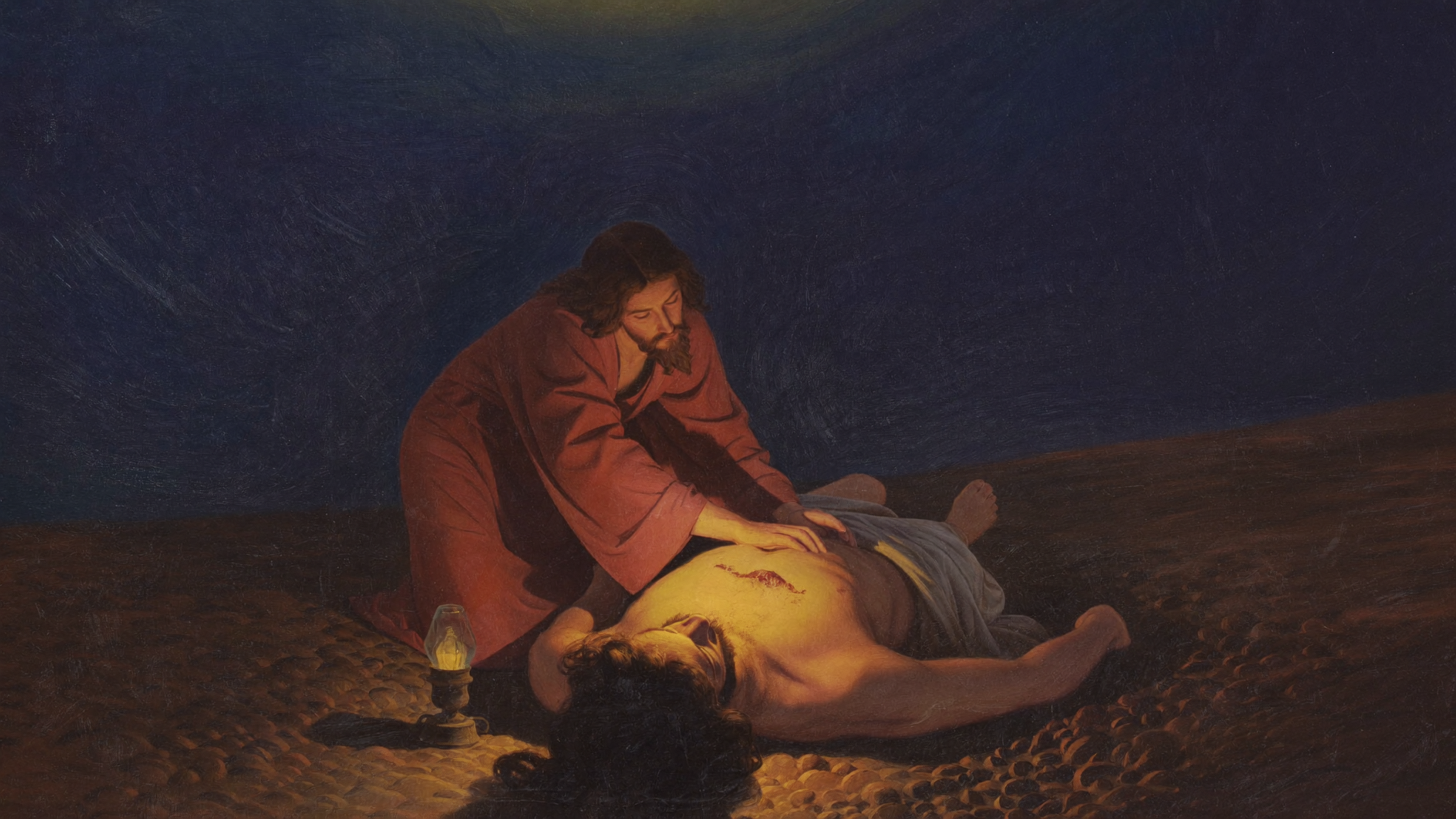
The Samaritan sees the beaten stranger — the very kind of person who would normally hate him — and he can’t just walk past. He doesn’t cross the road. He kneels down in the dirt. He cleans the wounds. He wraps them. He lifts the man onto his own animal and walks beside him. He brings him to an inn and pays for his care out of his own pocket. And he tells the innkeeper: whatever more he needs, I’ll cover it when I come back.
The enemy is the one who loved. The outsider is the one who got it right. And the holy men walked on by.
The question, turned around
Then Jesus turns to the man who started all this, and he asks his own question back to him — but changed. The man had asked, “Who is my neighbor?” — who’s inside my fence. Jesus asks, “Which of these three was a neighbor to the man who was hurt?”
Do you feel the switch? Neighbor is no longer a group you’re born into. It’s something you do. You become a neighbor the moment you cross the road toward someone instead of away.
And the man can’t even say it. He can’t make his mouth form the word “Samaritan.” He just mutters, “The one who showed him mercy.” And Jesus says, Go and do the same.
Be like the enemy. That’s the command. Be like the person your people taught you to hate — because he understood love better than the priests did.
Two ways this story is about you
Now hear this, because there are two ways this story might be about you.
Maybe you’ve been the man in the dirt. You know what it is to be down, and to watch the “good people” — the church people, the respectable ones — glance at you and cross to the other side. If that’s you, then hear the rest of it. Help was coming. And it came wearing the face of the person you’d been told to be afraid of. Mercy doesn’t always come from where you were taught to expect it. Sometimes it comes from the outsider — and it is still God’s mercy.
Or maybe you’re the one standing at the top of the road, sure you already know who your people are and who they aren’t. If that’s you, Jesus is being gentle, but he is not being unclear. The person on the other side of your fence — the one your side calls the enemy — may be closer to the heart of God than you are. Your job is not to figure out whether they qualify. Your job is to go and do likewise.
There is no fence. There never was. Jesus took the holiest people in the room and the most hated man they could imagine, and he handed the love to the one they hated. On purpose. So that no one could ever again ask “who counts as my neighbor” and get the answer they were hoping for.
If you want to keep sitting with this — the old stories, read fresh, and the kind of love Jesus actually came to teach — come find us online. There’s room at this table for you, whichever side of the road you’re on.